
Do You Need a Permit for Your Remodel? A Plain-English Guide
When Washington remodels require permits, when they don't, and why permitting matters when you eventually sell the house.
Permits feel like bureaucracy until you try to sell a house with unpermitted work in it. Here's a practical read on when they apply.
Generally requires a permit
Moving or adding plumbing, moving or adding electrical circuits, removing or altering load-bearing walls, changing the building footprint, adding or enlarging windows and doors, converting space (garage to living area, basement finishing), and structural repairs. When in doubt, assume yes and confirm.
Generally doesn't require a permit
Painting, flooring replacement, cabinet replacement in the same configuration, countertop replacement, fixture swaps in the same location, and cosmetic tile work that doesn't alter plumbing. Like-for-like replacement is usually the test.
The gray area
Replacing a tub with a shower in the same footprint, or swapping a vanity where the plumbing shifts a few inches. Jurisdictions differ. Your contractor should know your specific city, and if they shrug at the question, that's informative.
Why it matters at resale
Unpermitted work shows up in disclosure and inspection. Buyers can demand it be permitted retroactively, ask for a price reduction, or walk. Retroactive permitting sometimes means opening finished walls. What looked like saving a few hundred dollars becomes a real problem years later.
Insurance is the other reason
If unpermitted work causes damage — a fire from unpermitted electrical, water damage from unpermitted plumbing — your insurer may have grounds to deny the claim. This is the risk nobody thinks about until it matters.
Who pulls the permit
Your contractor should. If a contractor asks *you* to pull the permit as the homeowner, be cautious — it can be a way of shifting liability, and it may indicate they aren't properly registered.
In the Puget Sound specifically
Age does not decide whether you need a permit — scope does. An identical tub-to-shower conversion trips the same permit in a 1925 bungalow and a 2015 build. What age changes is how often a remodel here ends up in permitted scope, because opening an older kitchen more often means moving plumbing or upgrading a panel.
Want a straight answer about your project?
We'll look at it, tell you honestly what it needs, and put a free estimate in writing. No charge, no pressure.
Get a Free Estimate (206) 396-2959Common questions
Do you handle permits?
Yes. When work requires a permit we pull it — we don't ask homeowners to pull permits for our work.
Can we stay in the house during the remodel?
Usually yes. We seal off work areas and keep sites clean. If it's your only bathroom or kitchen, tell us early so we can sequence around it.
About the author: Veniamin “Ben” Plotnikov is the owner of Builders Enterprise, Inc., a general contracting and remodeling company based in Renton, WA. He has worked in construction across the Puget Sound since 1998, including several years specializing in natural stone and countertop fabrication.
The short answer
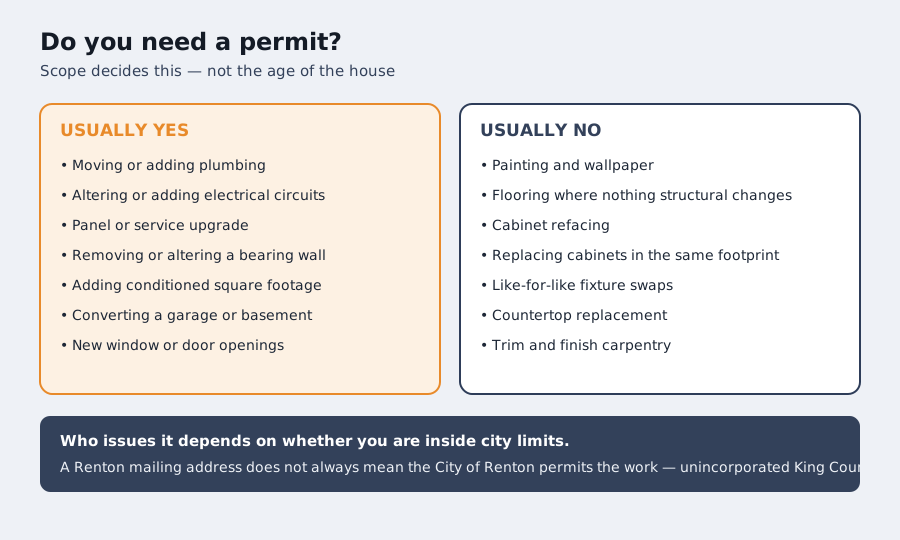
Age does not decide whether you need a permit — scope does. You generally need one to move or add plumbing, alter or add electrical circuits, do structural work, add conditioned square footage, or change the building envelope. You generally do not for painting, flooring where nothing structural changes, cabinet refacing, or like-for-like fixture swaps. Who issues it depends on whether your property is inside an incorporated city or in unincorporated King County — a Renton mailing address does not always mean the City of Renton permits the work.

Who issues your permit
This is the part that trips people up. Your mailing address says “Renton” or “Kent” but that does not always mean the city permits your work. If your property is in unincorporated King County — Fairwood, Skyway, parts of Cascade, East Renton Highlands — the county handles it, not the city.
| Where the property is | Who permits it |
|---|---|
| City of Renton | Renton Community & Economic Development, Permit Center, 1055 South Grady Way |
| City of Seattle | Seattle Department of Construction & Inspections (SDCI) |
| City of Bellevue | Bellevue Development Services |
| City of Kent | Kent Permit Center |
| Any other incorporated city | That city, regardless of which county it sits in |
| Unincorporated King County | King County Dept. of Local Services, Permitting Division |
If you are not certain which applies, the county maintains a parcel lookup and the cities all publish jurisdiction maps. It is worth five minutes — applying to the wrong agency wastes weeks.
Two paths, and which one you want
Most jurisdictions here run residential permits down one of two tracks, and knowing which one your project qualifies for is the difference between a couple of weeks and a couple of months.
- Reduced-review / subject-to-field-inspection. Seattle calls it a Subject-to-Field-Inspection construction permit; other jurisdictions use different names for a similar idea. Plan requirements are reduced because the work is simple, and much of the review effectively happens at inspection rather than at a desk. Typical qualifying work: remodeling part of a house, interior non-structural alterations, a detached garage, a small single-story addition.
- Full plan review. Required when the work is structural, changes the building envelope, or is large enough to need engineering. Slower, and there is no way around it when it applies.
A kitchen remodel that keeps the existing footprint and does not touch structure usually lands in the first category. Remove a bearing wall and it moves to the second, because an engineer’s stamp is now part of the package.
What generally needs a permit
- Moving or adding plumbing — relocating a sink, toilet, or shower drain
- Altering, adding or relocating electrical circuits; any panel or service upgrade
- Structural work — removing or altering a bearing wall, cutting new openings, altering framing
- Adding conditioned square footage, or converting unconditioned space (a garage, an unfinished basement) into living space
- Changes to the building envelope — new window or door openings, altering the roofline
- Mechanical work — new ducting, relocating equipment, some ventilation changes
What generally does not
- Painting, wallpaper, trim
- Replacing flooring where nothing structural changes
- Cabinet refacing, or replacing cabinets in the same footprint with no plumbing or electrical relocation
- Like-for-like fixture swaps in the same location
- Countertop replacement
The gap between those two lists is narrower than people assume. A kitchen where you keep the layout and swap everything is often unpermitted work. Move the sink three feet and it is not.
Ready to talk about your project?
Free estimate anywhere in the Puget Sound.